
During lunch recently with dear friends, one of them mentioned that her granddaughter got some emoji stickers and chuckled at the “poop” one. It made us all laugh thinking about it and got me thinking about things I’ve read about emoji. Truth be told, I love them and use them often; mostly in texts. Apparently, so do millions of others but do you know who created the cherished little cartoons, what research says about them, and that they created a growing job market?
First up, the research.
 The U.S. Emoji Trend Report was conducted by Adobe as part of its Future of Creativity study and it showed the vital role emoji play in our lives. In fact, the report found that 91 percent of U.S. emoji users agree they make it easier to express themselves and 71 percent say they can help spark positive conversations about cultural and social issues. They also help people overcome language barriers and form connections that would otherwise be difficult to do, empower self-expression, make conversations fun, impart personality into a conversation, and positively impact mental health. In fact, 73 percent of emoji users think people who use them are friendlier, funnier, and cooler than those who don’t. Pretty heady stuff for simple characters, right?
A couple of other interesting findings:
The top 5 emoji in the U.S.? Smile with tears, thumbs up, red heart, winking with heart kiss, and tear.
Sixty percent of U.S. emoji users agree that using them in their communications has improved their mental health. Insert “thumbs up” emoji here.
Emoji use at work improves efficiency, boosts creativity, and builds stronger relationships with 71 percent saying using emoji at work positively impacts likability and credibility and 63 percent saying they make team building more efficient. (The most effective emoji at motivating users at work are reportedly thumbs up and muscle arm.)
75 percent say its ok to only send an emoji as a quick response instead of words.
There are more positive emoji than negative ones.
Making an emoji a personal reflection of your race and appearance is as diverse as emoji users themselves. I personally use the brunette but other than that, all of mine are that yellowish-gold. To each his own, right?
Emoji are so part of our lives that there is an actual World Emoji Day every July 17. Who knew?
Yes, it’s true, inserting and using cartoon pictures of objects we love and feelings we feel can serve as words we can’t vocalize or write, but it’s important to note that certain symbols mean different things in different places so emoji etiquette is important.
 Some emoji are used in different ways with different people. Case in point, what many call “praying hands” some consider “high five.” Certain emoji also hold different meaning in different cultures. The “thumbs up” emoji is popular in the west but in some Middle Eastern cultures it is an offensive gesture. The same can be said about the “A-OK” hand gesture, which is distasteful in Latin America. And in Japan, the words for “poo” and “luck” sound similar, so it’s not uncommon to send a friend a “poo” emoji before an exam or job interview. Emoji don’t always mean what you might think they do, can differ in appearance from platform to platform, and are always changing. Remember when Apple ditched the handgun and replaced it with a water gun? Then there are the ones that are used in ways not originally intended such as the eggplant and the peach, but we won’t go there.
 So how did all this come to be and where did the name come from? It all goes back to 1999 when then 25-year-old Shigetaka Kurita of Japan designed the first emoji as a way to ease communication on a mobile internet system developed by Japanese telecom giant NTT DoCoMo. The system offered emails but was restricted to 250 characters so emoji offered a way to say more in a limited space. And the name? The word emoji comes from the Japanese e (picture or image) and moji (character.) Many consider them one of Japan’s most transformative modern designs but they still remained largely confined to Japan for more than a decade.
It wasn’t until 2010 that emoji were incorporated into Unicode, the standard that governs the software coding of text, when 722 emoji were released on both iPhone and Android. A year later Apple added an official emoji keyboard to iOS and Android followed suit two years later. At last count there are now more than 3,600 emoji with a new batch reportedly being unveiled next month.

Angela Guzman knows a little about this, as she was an Apple intern who, with a mentor, designed the company’s original emoji set including face with tears of joy, red heart, party popper, and pile of poo. (What many don’t know is that pile of poo, the same one my friend’s granddaughter giggled at, is also the ice cream on the ice cream cone.) Her first design was the engagement ring and she says one of the hardest to design was the dancer with the red dress. She and her mentor are today proud owners of a U.S. patent for the close to 500 characters they created.
Guzman is as surprised as anyone on how her and others’ creations have revolutionized communication and that emoji would eventually appear on everything from toys to stickers, apparel to candy, and the subject or characters of movies, books, and music videos. And get this, in 2016 the original emoji set was added to the collection at New York’s Museum of Modern Art. Emoji is an official work of art!
Two other interesting things I learned while researching all of this: emoji is not capitalized and there is no plural for emoji.
And just in case you’re wondering, my favorite emoji? In no particular order: praying hands, laughing faces, girl with hand up, girl with hand on face, girl with both arms up, face with heart eyes, sunglasses face, thumbs up, and eyes wide open face. How about you? Which ones are your faves?
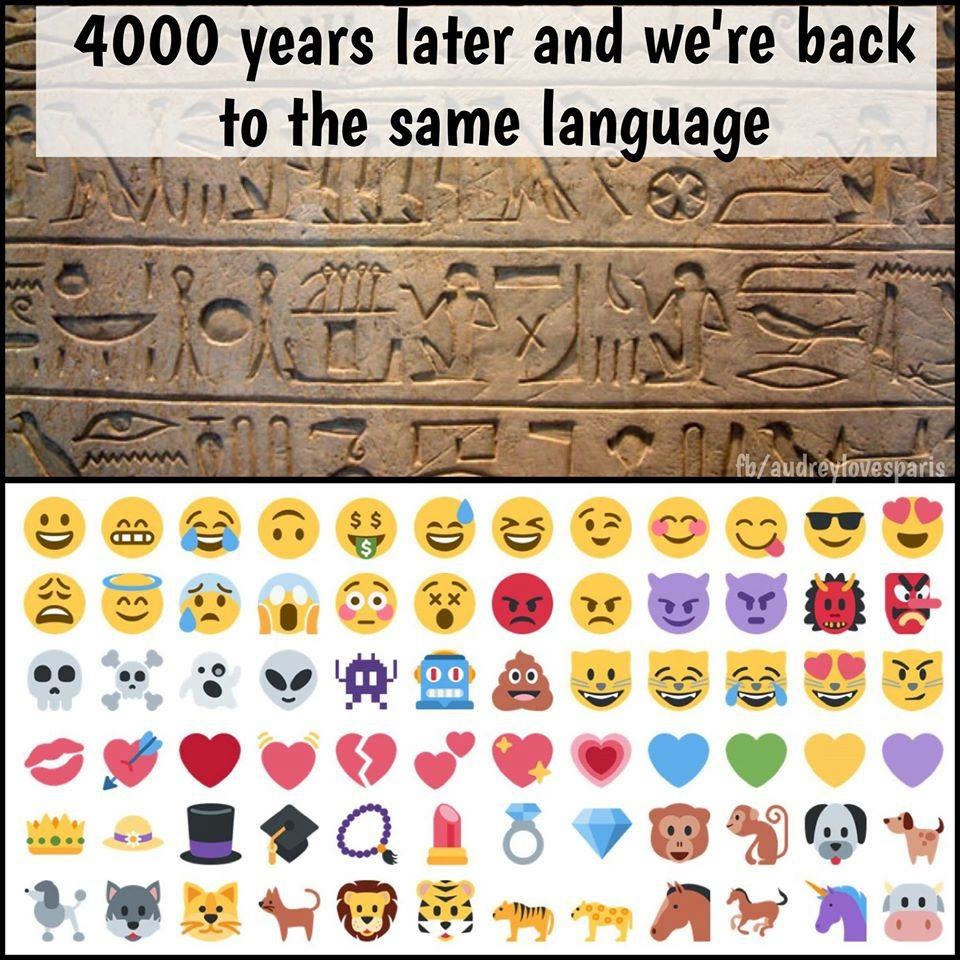 So, you think you have the skills and desire to design more little characters for society? There may be a job for you! Yep, Emoji Designer and Emoji Translation are growing job opportunities. Keith Broni from Ireland is said to be the first person in the world with the job title Emoji Translator; a position that many companies have created to help them navigate through the growing emoji minefield. Broni beat out 500 other applicants for the job and has since worked with PR firms, marketing departments, and multinational companies.
Other emoji spin-offs include an emoji spelling bee (how fun would that be?!), emoji convention Emojicon, Emojipedia, and emoji summer camps for kids with the requisite Emoji Art Instructor position leading the way. So prevalent are emoji that one UK linguist once said emoji was the country’s fastest-growing language. But, Rob Drummond, a senior lecturer in linguistics at Manchester Metropolitan University, says no way no how. He reports that a test for a language is that you have to be able to translate a full sentence from one to another with shared meanings and since emoji meaning vary from person to person, this is not the case. Still, the tears of joy emoji, considered the most commonly used one on the planet, was the Oxford English Dictionary’s word of the year back in 2015.
 So, the next time you insert a smiley face, praying hands, or champagne toast in a message, think about that little character’s backstory and you’ll forever want to give all the creative minds behind them a big thumbs up.
Discover more from Beyond Words
Subscribe to get the latest posts sent to your email.


 Beyond Words