Beyond Words

Words, Wit and Wisdom for Today's Style and Decision Makers

An Unrivaled Rivalry October 6, 2022

Filed under: Uncategorized — carlawordsmithblog @ 4:15 pm

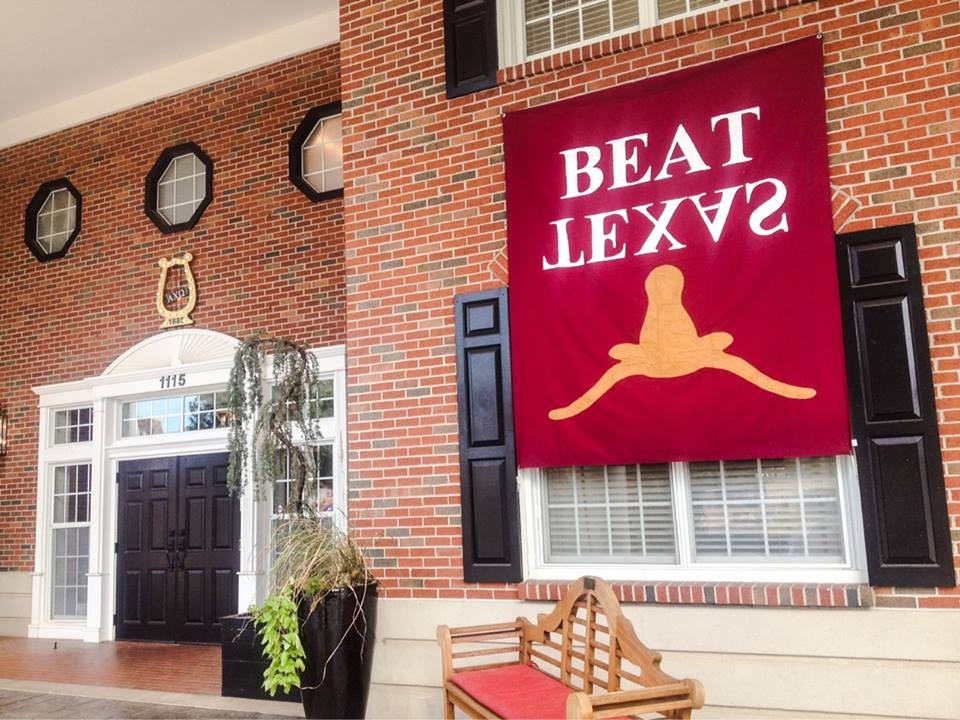
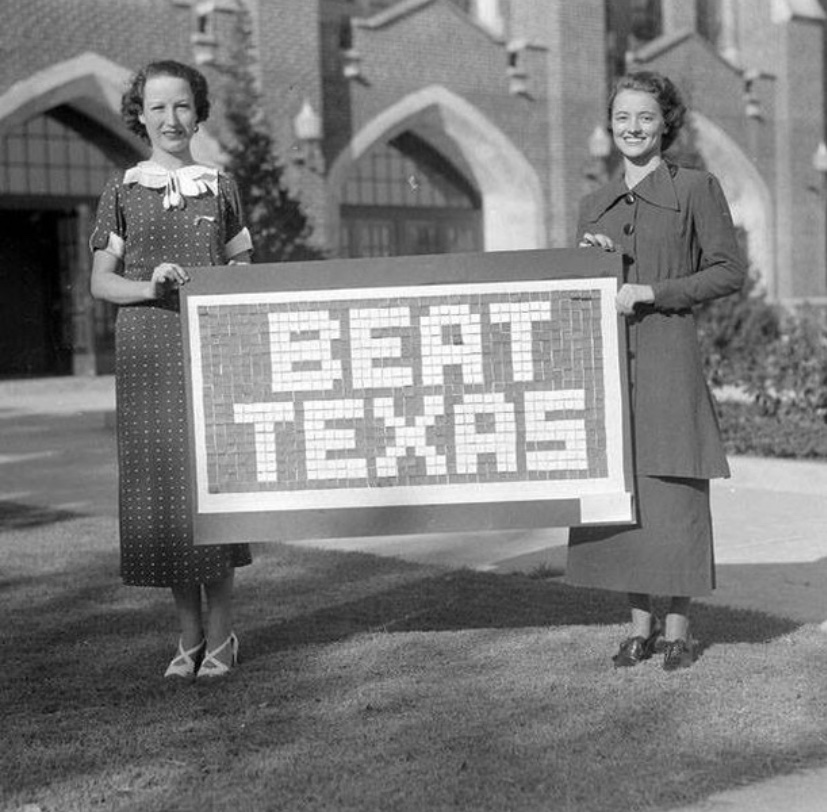
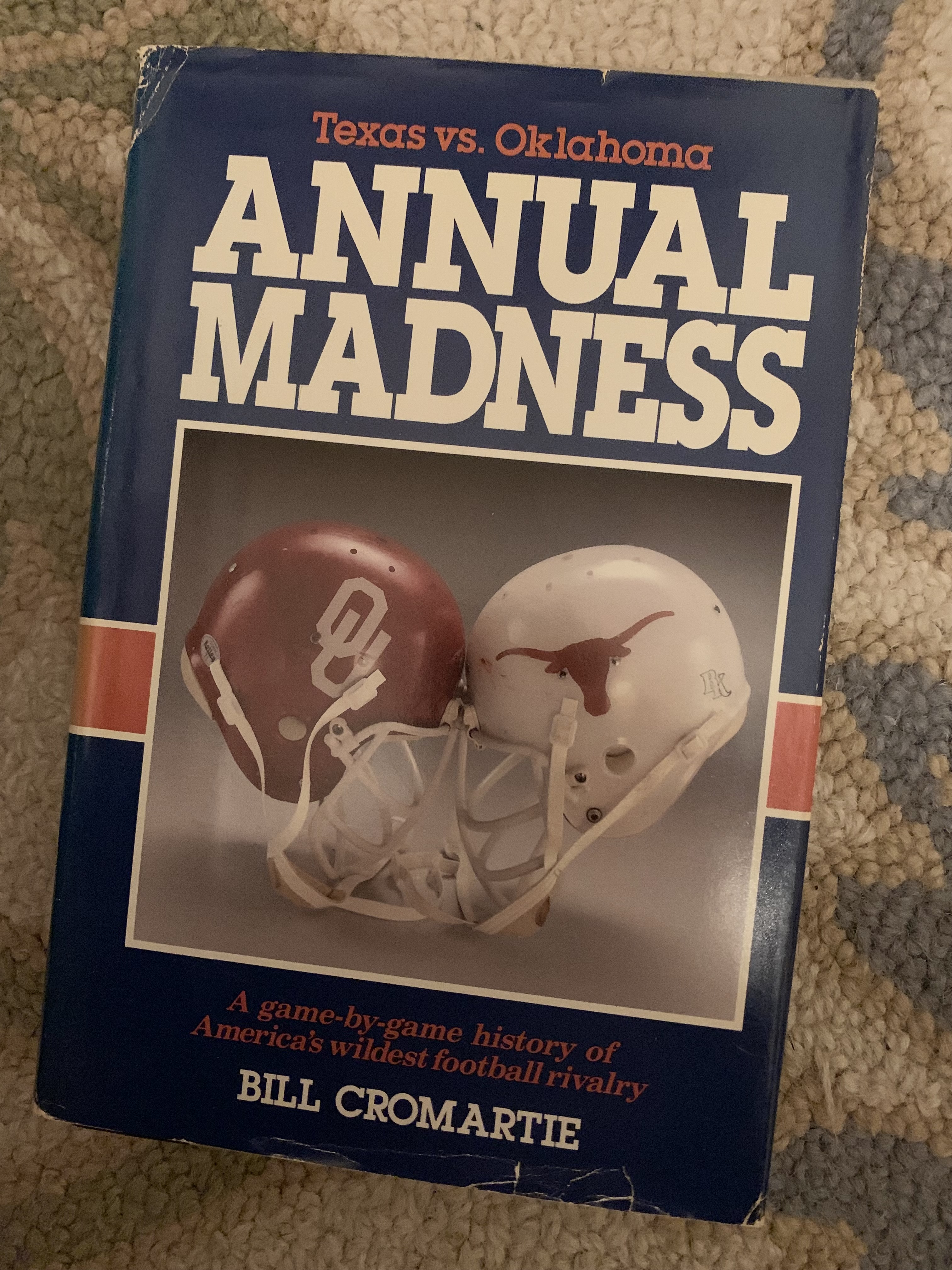
Red River Shootout.  Red River Rivalry.  Red River Showdown. OU-Texas.  Whatever you call it, it’s truly an unrivaled rivalry and brings out a two-sided disdain that is hard to explain. IYKYK. What time is it Sooners? Again, IYKYK. But why such animosity between two teams, two states, and two sets of fans?  It’s a mystery. It’s historic. And it can be a dream of a game. Or a nightmare.


I went to OU after being born and raised in Santa Fe, NM.  I really didn’t know what I was getting into and had never heard of OU-Texas weekend. I remember everyone making plans to go to Dallas for the game my first year there and thinking, “we’re going to Dallas for a football game?  I’m in!” I was in and I was in awe.


I have now lived in Austin for 36 years. You’d think that after that long I’d have a tiny bit of allegiance to the hometown team. Never. Ever. I could live in ANY other city or town in America (well, maybe not Stillwater or Boston) and be capable of rooting for the home team against anyone but my Sooners, but the Longhorns? No way. Jose. I don’t even like the color orange. It hasn’t always been easy living in the enemy’s backyard, but I’ve never wavered. Our daughter was Austin born but Sooner bred, is also an OU grad, and is as passionate about our Sooners as I am. Mamma done good and raised her right! Don’t get me wrong, I love my Longhorn friends but I love when my team beats theirs. If we could win only one game each year, hands and horns down I’d choose this one.


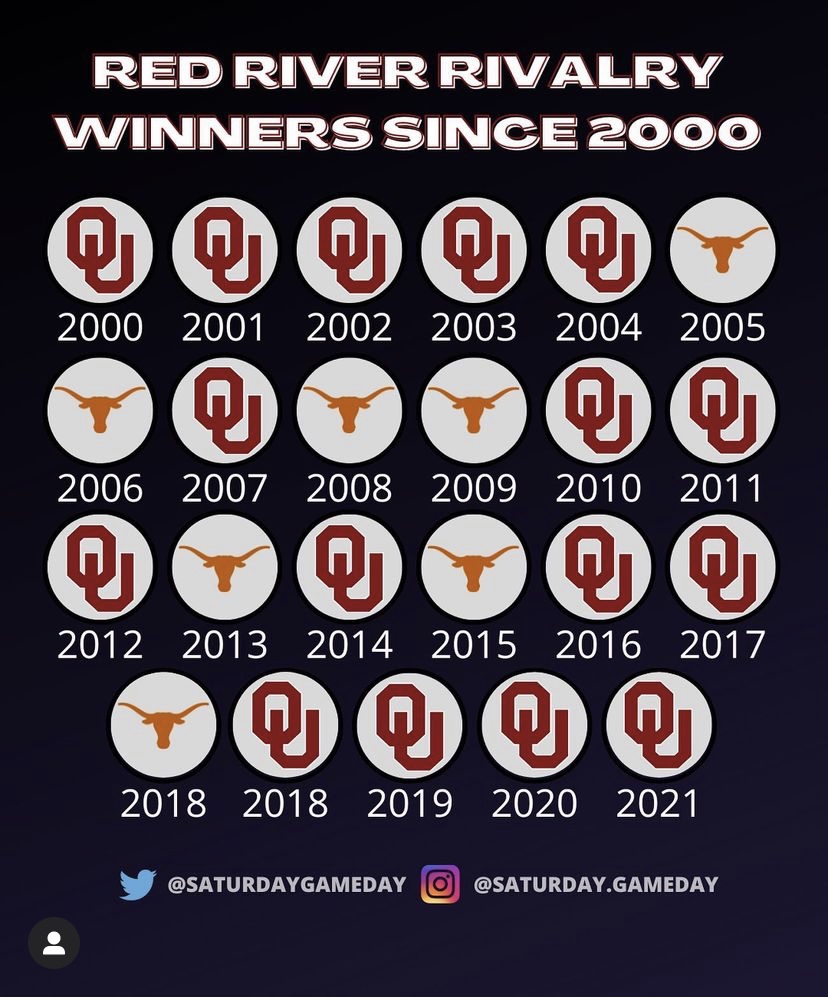
OU has won the last four games and has pretty much dominated the past 22 years, but as they say, you just never know. The favorite doesn’t always win. Rankings don’t matter. (This, sadly, is the first year since 1936 that neither team is ranked.) Records can be thrown out the window. Anything can happen and everything has. Fingers crossed.


It really is a rivalry unlike any other. There is something magical about the game named after the river that runs along the border of the two states. A river, I might add, that runs red.


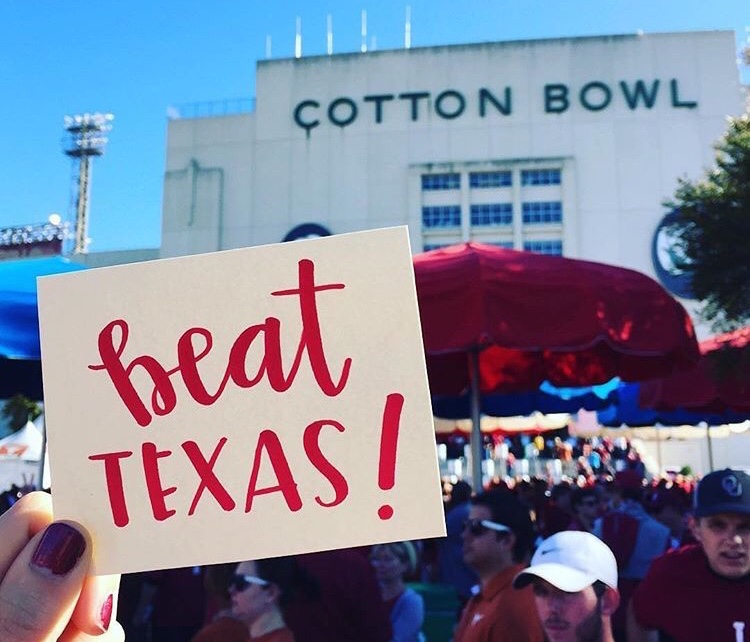
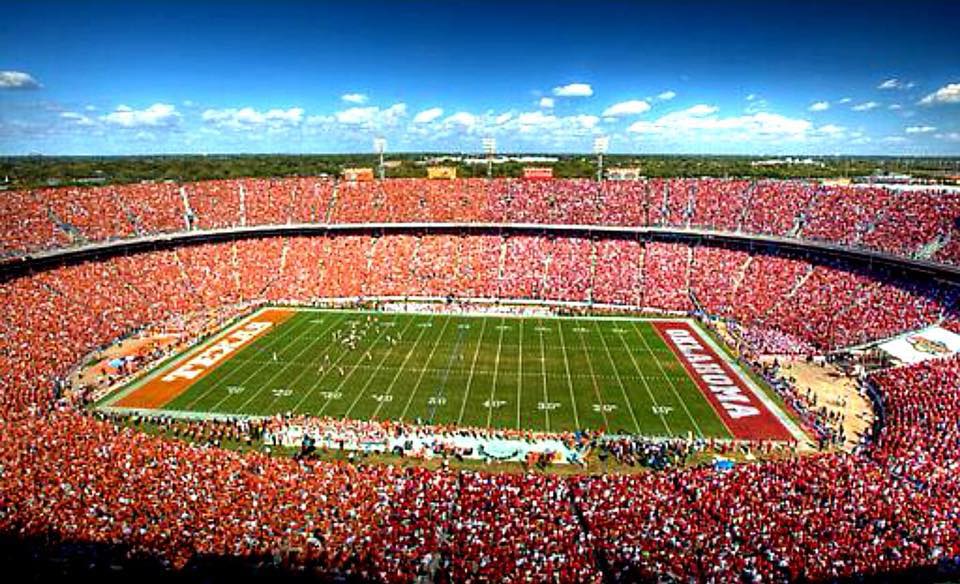
First off (kinda like Georgia-Florida), it is played every year on neutral ground at the old Cotton Bowl in Dallas. The venue is logistically half-way between the two schools and offers one of the most memorable experiences as a student. Being that the stadium sits right in the middle of the Texas State Fair just adds to the festivity. Mingle around the rides and fried food booths on the second Saturday of October and you’ll see nothing but Crimson and Cream and Burnt Orange. You’ll hear words and shouts you normally don’t (which is the main reason we never took our daughter to the game until she was in middle school!) and confidence will be at an all-time high.


Something else that makes the game so special is how the seating is configured. Normally opposing fans sit on either side of a stadium. Not so in Dallas. The Sooner and Longhorn faithful are configured in two “U” shaped areas and each gets an end zone. Those lucky enough to get 50-yard-line seats are also unlucky in that they sit right next to their opponents. This proves awesome for the winners, but for the losers, it is crushing. The seating also means that walking out of the stadium is a firsthand lesson in humility and embarrassment for the losers as you are walking down the ramps shoulder-to-shoulder with the winners and amid jeers that your team sucks. There is often talk of making the game a “home and away” series, but each time it’s voted down. As a dues paying OU alum, I steadfastly vote no and always will and I’m hoping this stays the case when both teams go to the SEC. I remember how much fun it was to go to the game as a student and I want that same thrill for every current and future student.


It all started back in 1900 and the rivalry has been renewed annually and uninterrupted since 1929, which is also the year the game moved permanently to Dallas. Texas leads the series 62-50-5 but OU has been better than .500 since the end of WWII. In a classic “be still my beating heart” year, OU and Texas met twice in 2018…once in the Red River Showdown and again for the Big 12 title, both of which the Sooners won and with the latter, the classic ten-gallon Golden Hat trophy to take home to Norman.


But why the hatred between two legions of fans that are really so similar? Being that I didn’t grow up in either Oklahoma or Texas but having lived in both, I can honestly say Okies and Texans are very, very alike. I know they both hate hearing this, but sorry friends, it’s the truth. Dallas and Oklahoma City have the style and swagger, OKC and Houston have the oil history, and Tulsa and Austin have the rolling hills and a river running through them. In between them all are small towns filled with good ole boys and gorgeous gals. Both states love their football, love their religions, and love their guns. They are both, for the most part, friendly types and are the subjects and writers of many a country music song. But, when it comes to this game, they are anything but similar or civil.


Full disclosure: I’m very nervous this year as the Sooner team and program as a whole was gutted just mere months ago thanks to a contemptible “man” whose name I won’t mention. We have a good guy on board in Brent Venables, but we are also injured and young. Last year’s amazing comeback was tough to sit through so this year I’ve made a tee time during the game. I can’t watch. I admit it. If we lose, I won’t have to witness it and if we win, I’ll still be thrilled. I’ll have my OU head covers on, am flying an OU flag outside my Austin home, and will be hoping and praying it’s those wearing crimson and cream who are happy walking down those ramps and those who played the game wearing that cowboy hat trophy. I’d take that over any hole-in-one.


Boomer Sooner!


A Bit Uneasy About the Big Easy but History and Food Called October 4, 2022

Filed under: Uncategorized — carlawordsmithblog @ 7:17 pm

About twice a year my husband has business in the New Orleans area and every now and then I tag along just for the fun of it. I love history, food, live music, fun, and travel so NOLA has always been a great place to find all of the above. I decided to go with him last month but the day prior to our trip, we heard (and plenty of friends and family made sure we had) that New Orleans now has the highest homicide rate of any major U.S. city, up 141 percent. Not what you want to hear as you’re packing your bags, but considering it was a business trip for my hubby, the trip had to be taken…at least on his part. So, we headed to the Big Easy a bit uneasy but since we know the city well, we knew where we wanted to go and where we wanted to avoid. We for sure wanted to go to Drago’s for their uh-mazing chargrilled oysters and we knew we wanted one nice dinner. We did both. We wanted to avoid being out at night so we didn’t visit our favorite Frenchmen Street for some fun and authentic live and second line street music. Bummer, but better safe than sorry.


The city’s crime was certainly the talk of the town, and that’s saying a lot in a town where you have sooooo much more to talk about. (And can we talk briefly about that accent? It’s got to be one of the hardest to imitate and is so yummy to listen to.) Apparently the home of the Saints is now home to a record number of sinners and locals are praying it all changes soon. Keep in mind this is a city that lives and breathes on tourism with nearly 20 million visiting each year. In short, the majority says the police have been defunded, are at 50-60 percent capacity, predators know they won’t be prosecuted, and we as a society are raising a generation pretty much immune to consequences or standards. We have emboldened the worst part of our society and now we are dealing with the consequences. Funny how that works, right? And as we all know; it’s not just New Orleans.


Even though NOLA’s homicide rate is now four times that of Chicago, the Windy City is known as much for its crime as it is for its hot dogs and baseball teams. We see almost daily smash and grabs on the news and social media as well as car-jackings, which are up 210 percent in New Orleans. Two-hundred-and-ten percent! Insane, right? New Orleans is just the latest city to see its crime rates skyrocket and follows the likes of Chicago, Detroit, Baltimore, Portland, and others. I don’t think I need to ask what all those cities have in common but I will ask when are we as voters going to say enough is enough?  It’s so obvious it’s glaring and glaringly embarrassing for all of them.


But that’s not why I’m here today. I’m here to talk about the other New Orleans. The historic city synonymous with imaginative food and imaginative fun. It’s just so sad to see such a unique and historic city feel the blight of historically bad leadership but the history is still there and I got a great taste of it…both literally and figuratively. (One thing I learned that locals are adamant about is that those sweet candies made with sugar and nuts are “prah-leens,” not “pray-leens.”) Got it!


Drago’s chargrilled oysters

Food-wise, and you can’t talk New Orleans without talking food. Like it or not, I challenge you to name five cities worldwide synonymous with their local dishes and not have New Orleans on it. Not only is it famous; it’s worldly. Gumbo is the West African word for okra; French, Spanish, and African settlers begat Creole cooking; Germans introduced sausage; Italians pioneered the muffuletta; and Yugoslavs innovated the oyster industry. Today NOLA fisheries gather 20 percent of the nation’s oyster crop, which is considered the juiciest and briniest anywhere.


From the beginning, local foods have been experimental and to this day, local chefs and meals are well-tuned in the art of making do with what is at hand and nothing goes to waste. You could say “improvise” is the main ingredient.


As I’ve done on a visit a few years back, I took a cooking class at the New Orleans School of Cooking. I blogged about this back in https://carlawordsmithblog.wordpress.com/wp-admin/post.php?post=10472&action=edit and explained the difference between Cajun and Creole food, what “The Holy Trinity” of the foods is, and where to find the best of both. It’s all fascinating to me.


For something new this time, I took an architectural walking tour of the French Quarter. We’ve all heard of it, many of us have been there, but how many of us really know the history of the famous Vieux Carré? Again, fascinating.


First, a brief history of The Crescent City, called that because Mississippi river takes a crescent shape at the city. The French founded the colony they named La Nouvelle Orleans in 1718 but by the mid-18th century it was under Spanish control. It was then that Acadians (later named Cajuns, who not only brought with them unique recipes and foods, but also zydeco music) came from present day Nova Scotia and New Brunswick. After the turn of the century, Spain let Louisiana slip back to France but Thomas Jefferson, bent on keeping it out of Napoleon’s hands, purchased the entire Louisiana Territory (this is where our U.S. history classes are recalled) for $15 million. By 1840, New Orleans was one of the largest and wealthiest cities in the Nation.


Today’s modern New Orleans still has its foot firmly planted in the past. The city has survived much and residents are tried and true survivors; hence the penchant for celebrating. It also has a penchant for nonconformity and order, which is just one of many reasons it appeals to artists and writers. All of its intermingled cultures have resulted in flavor in both food and the spirit of celebration.


Amazingly, much of today’s French Quarter has the same boundaries as when the French first laid it out in the 18th century and is a business center, tourist district, and residential area. To say New Orleans cherishes its French roots and heritage is an understatement.


Food-wise, many popular New Orleans dishes and foods incorporate or originate from French words, including remoulade, etouffee, beignets, hollandaise, and béarnaise just to name a few. Even the beloved King Cake is cousin to a French brioche.


And then there’s roux; the essential flavoring, coloring, and thickening agent made up of an equal combination of fat and flour. It is used in everything from gumbo to etouffe.


Most dishes are prepared in a single pot and slow-cooked and one of my favorites, red beans and rice, is no different. Today, most local restaurants offer it as their Monday special, a practice that hearkens back to when moms did the laundry on Monday and put red beans on to slow cook while the wash was done. New Orleans loves its rice, and only China eats more per capita than the Big Easy.


But enough about that; here are just a few fun facts I learned as I walked the Quarter in the trusty hands of Guy with New Orleans Architecture Tours:


New Orleans was the first American city in which opera was performed and the first opera house in the U.S. was in New Orleans, which was home to three opera houses before New York City had its first. The original opera house is today the above Sheraton Hotel on Bourbon and looks much the same.


Although called the French Quarter, the French Quarter and New Orleans itself have a lot of Spanish in them as well.. Bourbon Street was originally called “Borbon Street.” The Bourbon Dynasty has reigned on and off in Spain since 1700 and most of those lacework balconies we all photograph and marvel at? They are of Spanish design and hometown favorite Jambalaya is distant cousin to Spanish paella.


And about those balconies. They, like all the iron fences seen around the Quarter are the stuff of legends but the stuff they’re made of varies. The fences are generally made from wrought iron while balconies are made out of cast iron, which bends easier. Ironically, cast iron is the pot of choice for all those Cajun and Creole cooks. Many are actually included in family wills!


Now for those colorful and classic shutters. Today they are mostly decorative but many are still used like their original purpose. They were originally functional board and batten style and were used to close off the fully open and unpaned windows. They were also louvered, which allowed individual slats to rotate open and closed to control privacy, light, and weather.


You see those shutters on balconies throughout the French Quarter but are they really balconies? Sometimes yes, sometimes no. As Guy the tour guide explained, a balcony is a narrow platform projecting outwards from a wall. They are not supported by posts or columns and can be “Romeo and Juliet” small or stretch the length of a building. (yellow pic above).  A gallery is normally wider than a balcony and often hangs over the width of a sidewalk below. They are supported by posts or columns. (pink with green shutters pic)


One place that’s not the case is with beignets and chicory café au lait coffee at Café du Monde. Both , have been enjoyed locally since the 1800s and the Café itself is the oldest tenant of the French Market, a fun place to spend some time perusing and relaxing.


Since 1791 there has been a marketplace in the French Quarter. Today’s version has a fun tented café that hosts live music and some really cool dance competitions if you’re lucky. We weren’t lucky enough to see one this go ‘round but we did enjoy the music and the people watching.


Somewhere else you can do some people watching is at Pat O’Brien’s. Known for its raucous party atmosphere thanks in part to its signature cocktail, Pat O’Brien’s has quite a history of its own.


Built in 1791 as a private residence, it later became the first Spanish theatre in the U.S. Spanish turned to Irish when it was purchased by Pat O’Brien who ran a speakeasy in it. In the early 1940s, Mr. O’Brien introduced the famed Hurricane drink. Today the drink’s hour-glass shaped glass is recognizable the world over and is a popular NOLA souvenir.


On that note, did you know the term “cocktail” was coined in New Orleans? Antoine Peychaud came to NOLA from the island of Santo Domingo in the late 1700s and proceeded to make a brandy-based cure-all in his Royal Street apothecary and served it in the big side of a double-ended egg coup or “coquetier” in French. Voila! The rest is cocktail history!


Situated in the heart of the French Quarter on St. Peter Street, Preservation Hall presents New Orleans Jazz concerts over 350 nights a year and really has done so since 1961 in what is truly “Hall that Jazz.”


The story of Preservation Hall dates back to the 1950s at Associated Artists, a small art gallery at 726 St. Peter Street in New Orleans’ French Quarter. Upon opening the gallery the proprietor Larry Borenstein found that it curtailed his ability to attend the few remaining local jazz concerts so he began inviting musicians to perform “rehearsal sessions” in the gallery itself. The jam sessions became more frequent and popular so much Borenstein moved his gallery to the building next door. One day while honeymooning in the French Quarter, Allan and Sandra Jaffe followed some musician friends to “Mr. Larry’s Gallery” at 726 St. Peter Street and fell in love all over again. This time with the music and the place. Borenstein eventually passed the nightly operations of the hall to Allan Jaffe and Preservation Hall as we know it today was born. The small, intimate venue made up of one single room with worn floorboards, supported the unique culture of traditional jazz in New Orleans, which developed in the local melting pot of African, Caribbean, and European musical traditions at the turn of the 20th Century. Preservation Hall was a rare space in the South where racially-integrated bands and audiences shared music together during the Jim Crow era.  Since its opening day, more than two million people have walked through its door including presidents, prime ministers, movie stars, and rock idols…and yes, the occasional jazz great.


Former Creole Cottages can be found throughout the French Quarter. They were popular from 1790-1850 and were the most common house type found in New Orleans during the early 1800s. Built very low to the ground, each had four rooms, two fireplaces, two small rooms in the rear, and two front doors that could be switched depending on weather and guests. Famous NOLA restaurant Arnaud’s has a private dining room called The Creole Cottage.


If you’ve walked the streets of the French Quarter you’ve probably noticed an array of lanterns. I certainly have as I am a lantern fanatic. I love lantern-style lighting and take note of them anywhere I go. In New Orleans they are everywhere and in my mind, act as adornments to the city’s timeless architecture. In fact, NOLA is probably the American city most associated with lanterns. Sorry Charleston.


It all started in 1792 with Governor Carondelet organized a group of night watchmen to ensure safety in the very dark night streets. Oil lamps were hung by iron at intersections but were a bit dim. In 1824 James Caldwell introduced the gaslight and soon after created the New Orleans Gas Light and Banking Company. By 1900 electric arc street lights covered the city and around 1920 replicas of the charming cast-iron gas lamps were installed and are still in on city streets today.


The first pharmacy in the U.S. was in New Orleans and today the site is a sweet little pharmacy museum.


Authors William Faulkner, Tennessee Williams, and Truman Capote all lived at one time in New Orleans and wrote some of their famous tales while there. Faulkner’s former home is today a charming small book store and is always one of my favorite stops when I’m in town.


Storyville was the original “red light” district and when it was shut down it moved to Bourbon Street, which is where Jazz started.


Much of the city lies five feet below sea level! This is why cemeteries are above ground. Tours of them are very popular but I for one will never go on one. I hear they’re popular and fun though.


Not everyone likes New Orleans and I can’t blame you right now for avoiding a visit. I do hope you learned some interesting things here though, and will perhaps give the city a chance in the future. Here’s also hoping the city and voters figure things out and restructures the place back into somewhere we will all want to “geaux.”


A Queen for All Ages September 10, 2022

Filed under: Uncategorized — carlawordsmithblog @ 12:31 am

Waking up today without a queen. It’s all still sinking in. It’s so very weird to think I’ll never see her again in that carriage or on that balcony. She was never considered a classic beauty like Princess Diana or Grace, but she proved beauty is way more than skin deep. Oh sure, I never met her and I’m clearly not from Great Britain, but like much of the world, I am sad. And for any of you who live under a rock or simply don’t stay informed, here’s why: Her Royal Highness Queen Elizabeth II died yesterday. She was 96 and was the world’s second longest-serving monarch. (France’s King Louis XIV reigned for 72 years, ranking him numero un.) In a word, she was living history and today I’m celebrating her life.


It was a life filled with joy and sadness and she has valiantly been at the center of so many historic events. As a young woman she witnessed the horrors of WWII and as a mature monarch she lived through the challenges of a pandemic. Perhaps 1992 was among her most challenging, a year she famously described as an “annus horribilis” as her family fractured and Windsor Castle caught fire. Princess Diana’s death is 1997 was a tough one too and you could say she’s not been quite the same since Prince Phillip’s death is 2021 and Megzit, when her grandson Harry and his American bride Meghan turned their backs on Harry’s royal background and family and fled to Hollywood. And yet, she handled it all with grace and dignity. She never complained and was a remarkable loyal servant. She was devoted to serving her people and duty was of utmost importance to her. She apparently had a wicked sense of humor too!


Time out here. Any of you who know me know I love royalty, particularly the British Royal Family (with the exception of a few). You also know I was and still am a bit obsessed with the late great Princess Di. Many of you called, texted, and messaged me yesterday saying you were thinking of me. So sweet! Today though, it’s all about Queen Elizabeth II, whose death officially brought an end to the second Elizabethan Age. It was a historic reign and yesterday was a historic day. Funny thing though, the longest reigning queen was never really supposed to be one.


Getty Images

It was her uncle, Prince Edward, who was next in line to the throne after his father King George V. But, in true scandal fashion, Edward abdicated the throne when he was not allowed to marry his American socialite love, Wallis Simpson, who was twice divorced. They ended up marrying but were considered persona non gratas in “The Firm,” which is what the House of Windsor is often referred to as.


So, in comes Elizabeth’s father and Edward’s younger brother, King George VI, who was named king. But he ultimately died at a young age, and so Elizabeth, at an even younger age and as his eldest child, became Her Majesty the Queen in 1952 at the age of 25. Even the beginning of her reign is the stuff of legends.


Young Elizabeth is crowned Queen in 1952. Let’s think about that for a minute. 1952. Harry Truman was U.S. president and get this; Joseph Stalin was head of the Soviet Union. And she was 25! What were you doing at 25 and could you have led a bevy of nations and done so with poise? Her amazing reign spanned 15 British prime ministers, 14 U.S. presidents, and seven popes. She is the last surviving head of state to have served during WWII and she reigned for roughly 30 percent of U.S. history. Again my friends, we’re talking history here.


What we’re not talking however, is ruling. You’ll notice “reign” is what she did. Queen Elizabeth never “ruled.” Even as Her Royal Highness, she was more of a ceremonial leader than actual ruler. The power to govern rests with Parliament but the Queen did appoint the nation’s Prime Minister and met with him or her weekly, as seen in “The Crown.” Fittingly, this monarch for life worked until the very end, appointing new Prime Minister Liz Truss just two days before her passing. Her official title was “Elizabeth the Second, by the Grace of God, of the United Kingdom of Great Britain and Northern Ireland and of Her Other Realms and Territories Queen, Head of the Commonwealth, and Defender of the Faith.” Whew! That’s a mouthful even in a beautiful English accent!


The last part means she was also head of the Church of England, which has been the case for each sovereign since 1534, when Henry VIII’s divorce debacle led him to renounce the Catholic Church and basically start his own.


To be sure, the Queen of England wasn’t just queen of England, She was also Queen of Scotland, Wales, and Northern Ireland, which make up the United Kingdom; and Queen of nations that make up the Commonwealth and include Canada, Australia, New Zealand, the Bahamas, Belize, Jamaica, and others as well as a host of other territories, including Bermuda, the Falkland Islands, and Gibraltar. At her death she was also head of state or recognized as Queen in wholly independent sovereign states too many to list here. Trust me, it gets confusing so I’m not even going to try to hash it all out.


Pretty big job for anyone, right, much less a young sheltered lady living in the 1950s? It was a man’s world and yet she mastered it brilliantly. You could say she was the original working mom and that’s just one of many reasons why Queen Elizabeth was voted one of the top three most respected women in the world for years on end. Amazingly though, you never saw her being bossy or arrogant. She likely despised today’s “all about me” and “my feelings” mantras and very well could have been the last dose of sanity in an ever growing insane world. She was the constant steady and stable amid constant changes even when her family and the events around her weren’t. I’m confident that we will never see another like her and that yesterday marked the end of an era.


Note: You hear the terms “UK” and “Great Britain” thrown around a lot so here’s the proper particulars. Great Britain is an island on which most of England, Scotland, and Wales are located. The United Kingdom is all of Great Britain plus Northern Ireland and is a country and sovereign nation that exists as a political union between the four countries. These countries have their own local governments and autonomy but are not considered sovereign nations, meaning they can’t negotiate international treaties or declare war. Basically the UK is a political term and Great Britain is a geographical one.


Good to know, right? Here are also a few fun facts about the Queen. She was the first monarch to be featured on British bank notes, never took a driving test and wasn’t required to have a driver’s license, and could travel the world without a passport. Oh to be queen!


Queen Elizabeth fittingly passed at her beloved country estate Balmoral Castle in Scotland. An outdoorswoman at heart, she loved riding her horses and roaming the grounds. And I love that she loved dogs! Princess Di, on the other hand, notoriously hated going there and it was where Charles learned Diana had been killed in that car crash in Paris. I wasn’t happy with how the Queen handled Diana’s death but I do admire how she allowed it to soften her stiff British upper lip and monarchy just a bit. She was steadfast in tradition but knew when it was wise to change with the times. It all comes full circle at a castle in Scotland.


Charles had to once again leave Balmoral under somber circumstances and now we have King Charles III who upon his mother’s death, immediately became king although no specific schedule has been announced for his official coronation. This will take me some getting used to as will “Queen Consort” Camilla. I cannot help but imagine what a glorious Queen Diana would have been if Charles had been the husband she deserved and just can’t stomach Camilla actually being queen.  It will likely be a short reign for the two lovebirds as, at 73, he became the oldest to assume the throne. Fingers crossed that he continues his mother’s style of reign and if anything, stays politics-free even though he hasn’t as the Prince of Wales.


So here we find ourselves, mourning along with Britain again. It won’t hit me like Diana’s death did, but it’s a mourning unlike many will see in their lifetimes. Charles delivered a touching and beautiful address to the nation today as he called the Queen “muh-mah” and appeared emotional at times. I LOVE that he named William and Kate Prince and Princess of Wales and concluded his address with words that gave me chills and brought a little tear to my eye. In part, they were:


“To my darling Mama, as you begin your last great journey to join my dear late Papa, I want simply to thank you. May flights of Angels sing thee to thy rest.”


I’m pretty sure angels are rejoicing and welcoming an angel of a queen to the ultimate castle and throne. Well done Lilibet. Beloved mother, matriarch, and monarch you’ve earned a well-deserved rest. God’s speed your highness.


NOTE: As monarch, the Queen will be given a state funeral. Per Buckingham Palace, “Following the death of Her Majesty The Queen, it is His Majesty The King’s wish that a period of Royal Mourning be observed from now until seven days after The Queen’s Funeral.” It’s expected the Archbishop of Canterbury will lead the service and in the days prior, the Queen’s body will lie in state and the public will likely be able to pay their respects. What I would give to be there!


Rocky Mountain Highs…and Lows August 24, 2022

Filed under: Uncategorized — carlawordsmithblog @ 5:15 pm

I wrote this as I sat in Ruidoso, NM gazing out the window watching a majestic rain storm pound our outside deck and clouds slowly blanket the mountain peaks normally in full view. This charming small town in southcentral New Mexico is special and it’s long been special to my husband and me.  It’s where we met. Long story short: I was working at a TV station in El Paso and he had moved from Boston to Houston. One of the sports anchors I worked with went to college with my hubby in New York so he came to El Paso to go skiing with him. A bunch of us from the station tagged along and the rest is history. I broke up with my college boyfriend of four years who was back in Oklahoma in law school, chose the boy from Buffalo, and all these years later we venture back to Ruidoso as often as possible. We love that it’s a true escape and still somewhat authentic.


In the summer, it’s a somewhat secret hamlet of warm weather pursuits such as golf and the famous Ruidoso Downs race track. There are also plenty of casinos, outdoor activities, family fun, and a handful of excellent restaurants. Peek out the window of the house we stay in or drive along the beautiful route into town and we see deer, turkeys, and a giant and massive antlered Elk we’ve named “Bucky.” At night we hear coyotes howling and our house has a sign alerting us that we’re in bear country and all that that means. In a word, it’s all beautiful and blessed.


Ruidoso’s main street is home to many darling and unique yet for the most part, affordable, shops and restaurants. In the winter, the Rocky Mountains’ most southern ski resort, Ski Apache, opens up to downhillers and shredders alike. Still, with all its amenities and beauty, Ruidoso remains somewhat under the Aspen and Santa Fe radar. As a native Santa Fean, I know exactly what that means. As a long-time Texas resident though, I also know Texans love Ruidoso as it’s a fairly easy drive from most of the Lone Star State. In fact, the vibe here is much more western then southwestern.


Montana by Ben Adkison

As I sit here watching the rain outside and golf on TV, I’m also reading an interesting magazine article in “Town & Country” that confirms our decision to head west and not northwest. The article details how Montana has become anything but a quiet get away. Go to Montana. Post on Instagram and Facebeook. And go on to the next destination. So much for chilling, practicing some soul care, and just taking in God’s landscape. But, good to know as we actually considered going to Big Sky Country this summer but it all became stressful and complicated to plan. Instead, we decided it’s much easier to pack the car, the dogs, and drive to our quiet little slice of heaven.



As with anywhere it seems, America’s Wild Wild West is sadly morphing into anything but. The magazine article, written by Antonia Hitchens, details the timeless dream of home on the range has been inundated by travelers and land buyers. In fact, 1.2 million acres were sold in Montana last year and Bozeman is now unaffectionately called “Boz Angeles.” Rumor has it that a California developer bought almost all of the remaining land around one town and Rupert Murdoch’s Montana ranch had a selling price of $200 million last year. With the median asking price for a single-family house in Bozeman now topping $905,000, many Big Sky realtors are telling potential buyers to buy any house or land they see as there may be little left very soon. It seems a ranch out west is the new house in the Hamptons. Oy.

 

Blame Keven Costner. His hit TV show “Yellowstone” has created a deluge of interest in places to escape to and feel the fantasy of the American West. Blame also the work from home craze. Post-pandemic workers realize they can indeed work from anywhere. Why not Montana? The owner of Ranch at Rock Creek…what many consider the most expensive ranch in America… put it simply to “Town & Country” when he said, “The match was lit and Montana is on fire now.” It’s happened in Colorado; Rockefeller’s Jackson Hole; and Hemingway’s Ketchum, Idaho and now in addition to Montana, Spokane, Washington and Coeur d’Alene, Idaho are cold weather hot spots. But it’s different now.


Gone are the days of packing the fam and renting or buying a rustic little place in the mountains or valleys. Small town charm has big bonuses but tell that to Aspen. Today’s buyers want exclusive and private enclaves that those in lines in Yellowstone and Grand Tetons National Park can only dream about. For example, the uber-exclusive Yellowstone Club in Big Sky not only boasts expansive and expensive homes and a golf course, but also the world’s only private ski resort. “Five-star living dressed up as frontiersmanship” as it is now described. Not exactly frontier authenticity but fabulous I’m sure.


So massive are many of the new developments that the gates to them rival those of entrances to nearby national parks. Elk antlers are all the rage and real Montanans reportedly consider Big Sky the Monaco of Montana. Who knew Montana and Monaco would ever be uttered in the same sentence.


So what is it? What is making these “billionaires in Wrangler jeans” as Hitchens describes them, long for a western paradise but one stocked with Whole Foods and Starbucks? Many are just tired of their day-to-day struggles and stresses and to get away far away is something they yearn for and can afford. Oddly enough though, their quest to be alone is proving more and more crowded and the impact all the building and development is having on the once pristine environment goes against many a climate change advocate’s chirping.


It’s all very similar to “Yellowstone’s” ranchers versus developers plot lines and as realtor Bill McDavid says, “People fall in love with authenticity but then wonder where they’ll get organic hummus.”


I’m not a fan of hummus and truth be told, neither my husband nor I are big outdoors people. We love walking along the streets near the house we stay in in tranquil Ruidoso, but hiking and the like are not in our wheel zone.  And, after reading Hitchens’ article, I’m certain we’ll continue to choose New Mexico’s Lincoln National Forest over all the hype up north and out west. We’re just hoping it stays a secret. Shhhhh!


The Hottest Court in America August 13, 2022

Filed under: Uncategorized — carlawordsmithblog @ 9:00 am

Photo courtesy Doug Kapustin

As I wrote about in my previous post, the popular word game Wordle got its start during the recent pandemic. Something I dabbled in during the lockdowns and shut downs was Pickelball. I’d heard about it and since I love tennis, I thought I’d give it a shot. Just like Wordle, it’s taken the country (and some of the world) by storm.


When I first played Pickelball back in 2020, my neighborhood club had tennis courts but not official Pickelball courts so our pro improvised like many do and converted a couple of the tennis courts into Pickelball courts. It was so much fun and really easy to learn. Think of it as a brilliant combination of tennis, badminton, and table tennis aka ping pong. It’s a blast and it’s the fastest growing sport in America! It’s also a game for all ages and the whole family so it’s only fitting it was invented by a “mature” dad and his family.


The game was invented in 1965 on Bainbridge Island in Washington state by three dads – Joel Pritchard, Bill Bell, and Barney McCallum – whose kids were complaining they were bored and had nothing to do. Like all good dads, they put their heads together and said “challenge accepted!”


Returning home after a game of golf, Pritchard and Bell hit a hole in one when they looked at the property’s old badminton court but couldn’t find any badminton equipment. So….they improvised and began playing with ping-pong paddles and a perforated plastic ball. What fun they had and the next weekend McCallum joined them and soon the three created rules for their new game; rules that relied heavily on badminton.


Fast forward to 1990 and Pickelball was being played in all 50 states. By 2019 the newly formed USA Pickleball Association had nearly 40,000 members, representing a 1,000 percent growth since 2013. Maybe they should be in charge of our economy! Two years later membership reached the 50,000 milestone and the sport’s popularity continues to explode. So what is it? Why so popular?


For one, like I mentioned earlier, if you can walk and bend you can play Pickelball. It is fast paced, but you get the hang of it fairly quickly. That’s the other thing: it’s easy to learn. The spread of its popularity is also attributed to the fact that it’s thriving at community centers, school PE classes, YMCA facilities, and retirement communities; the latter of which you could call the major league of Pickleball. It’s the ideal sport for those aging into or in retirement age as much like golf, it can be played at any age. Just be careful.


With the rise in Pickelball popularity has come a rise in Pickelball injuries – especially among Baby Boomers. In fact, experts say the popular pastime is leading to a rash of injuries amongst the senior set. Overuse injuries like tendonitis, arthritis, muscle contusions, and sprains are common and issues like patella; and ankle, wrist, and elbow fractures that require surgery are not uncommon. This older yet ambitious demographic is more likely to have weak bones, putting them at a greater risk for fractures considering the sport’s notorious repetive quick starts and stops. Loving the camaraderie and activity it brings to their often secluded lives, retirees picking up the Pickleball paddle may start slow but many get the bug and begin playing several hours a day and several days a week. I know the feeling. A tennis player at heart, I took the sport up again in 2020 after many idle years and before you know it I was at a pain relief doctor complaining of lower back and hip pain. I thought I was active enough to become my beloved Chris Evert again, but my body said no way. Enter Pickeball…the perfect competitive yet friendly game.


Played either inside or outside, Pickelball brings people together and is always played in doubles, meaning you play with a partner and have less court to cover. It involves both a cardio health aspect and requires strategic and quick planning that keeps the brain engaged. Just be sure to stretch before playing and work on balance, stability, and cross-training. I’m thinking yoga and long walks.


Play is done on a court that’s the same size as a doubles badminton court and it’s striped similar to a tennis court with right and left service courts. Excitement is added with the non-volley zone in front of the net called the “kitchen.” Rule #1: stay out of the kitchen as volleys are not allowed!


Pickelball paddles are smaller than tennis racquets but bigger than ping-pong paddles, although their handle is short like their table tennis counterparts. The balls are unique in that they have holes throughout and come in fun colors; colors that must be a single color to meet International Federation of Pickell specifications.


Yes, there is an international governing board as many new clubs are forming worldwide. Many European and Asian countries are witnessing Pickelball mania and courts are popping up everywhere. Do I foresee a future Olympic sport?


And to answer the question of all questions, how did Pickelball gets its name? Well, not from the food product and not after Pritchard’s dog whose name was Pickle. Many theories presume that the dog was the game’s namesake but sweet Pickles was born in 1968, years after the sport was named and being played. So then, what’s the real story?


Although I love the idea of Pickelball being named after a dog, it really got its unique moniker from Pritchard’s wife Joan who was a loyal crew fan and thought the fact that Pickelball was a thrown together game made up of parts of other games, it was much like the just-for-fun “pickle boat” races that regattas often hold for non-starters in a separate competition. I know, not the greatest of tales, but that’s the truth.


Our neighborhood club recently constructed designated Pickelball courts and play has commenced. I recently returned to the court and gave it a shot but with our 100+ degree weather, it was just too dang hot for me; even in the evening. I plan to return to play as our temperatures subside and can’t wait to dink it over the net and win the match. See you there!


Word Up! August 11, 2022

Filed under: Uncategorized — carlawordsmithblog @ 5:55 pm

It’s not often that I jump on board anything trendy, but two things currently have my attention: Wordle and Pickelball. I’ve been working on blogging on both for a week or so and then I saw the Pickelball feature on “CBS Sunday Morning” (and thought…they stole my thought!) last week so I figured I better get a move on! First up…Wordle.


I was kinda late to the game but this wordsmith is obsessed with Wordle. I’d heard about it and then one day early this year a fellow golfer talked about it after a tournament and raised my curiosity. I looked into it but it seemed a bit confusing so I let it go. Then, my good friend got me hooked. Now, I look forward to doing it every day and share my results with her and another friend who I got hooked on it. I gotta say…I love it!


I also loved learning that it was developed by a software engineer who made it for his girlfriend as a pandemic distraction during lockdowns. I guess Wordle is one of very few silver linings to come out of it all!


Brooklyn-based John Wardle, the guy behind it all, is actually Welsh and originally created the game for him and his friend to play. It all went public in October 2021 and players started posting their results on social media. In January of this year, more than 300,000 people played the game, up from a mere 90 players in November 2021. By mid-January, more than 2 million people were playing it daily. This success didn’t go to Wardle’s head however. In fact, all the sudden attention left him uncomfortable so on January 31, his little game was purchased by The New York Times Company for an undisclosed low seven figures and the game was moved to the company’s website.


AP/Michael Dwyer

IYKYK, but if you don’t, here’s the gist. Every day a five-letter word is chosen and players try to guess it in six tries. You simply enter any letters that make up a legit word in the five squares and go from there. After every guess, the letters are marked either green, yellow, or gray. Green means that letter is in the word and is in the right position, yellow means it’s in the word but not where you put it, and gray means it’s not in the word at all. It’s amazing and fun that some days you get it in two or three tries and others you’re hoping your sixth guess is the right one. All players worldwide guess the same word and there’s only one word per day.


So how are the words chosen? They are randomly picked from a list of just over 2,300 English words; a list that was pared down from the approximate 13,000 five-letter words in the English language by Wardle’s wife. It’s important to note that even though Wardle is Welsh, he is a long-time New York resident and all Wordle words use America spelling. That stuff that makes up fabric or your digestive system healthy? It’s “fiber” not “fibre” on Wordle. This doesn’t sit well with some foreign players, but no worries, Wordle has been adapted into other languages and now there are at around 350 different variants in some 91 languages. As for offensive words? They’re out. You’ll never guess “lynch” or “sluts” as the daily word, along with a few others.


There are some fun knock-offs out there, including Tradle, in which users guess a country based on its exports, and Airportle that involves guessing airports IATA codes. There’s also Heardle where listeners guess songs and that was acquired by Spotify just last month.


If you’ve played it, you might notice that Wordle’s mechanics are nearly identical to Jotto, the popular “write it down” game of the 1950s as well as the TV game show Lingo. Its method of playing is also similar to the board game Mastermind.


And speaking of board games, The New York Times and Hasbro have partnered to create Wordle: The Party Game, a board game set for release this October…just in time for holiday giving! Lots of clones have also appeared including many that incorporate the “le” suffix to appear connected with the original, but imposters have been removed and The New York Times filed a trademark application to protect its intellectual property. (Remember trademark info in my previous color blog?!)


It all almost didn’t happen though. Wardle had been doing his puzzling for roughly five years when he lost interest in 2014 and promptly set his prototype aside. Then, the pandemic hit. That’s when he and his friend became obsessed with The New York Times’ Spelling Bee and daily crossword puzzle. Wardle had created two online social experiments called The Button and Place while working for Reddit and in January 2021 he published Wordle on the web. And yes, he named it that as a play on word of his surname. It’s perfect!


The rest, as they say, is history. Today even Wardle himself plays it and says he doesn’t know each day’s word so he’s guessing right along the rest of us. He’s adamant about keeping it to one puzzle per day as a way of keeping players wanting more and also as a way of only spending mere minutes on it each day. In short, he just wants it to be fun and what’s a five letter word for fun? Wordle!


In Living Color August 9, 2022

Filed under: Uncategorized — carlawordsmithblog @ 7:16 pm

College football is almost here and being a huge fan, I cannot wait. But, since I promised a follow up blog to my one yesterday on color, the game of football itself has to wait but color does play a big role in the sport so let’s kick off this blog with a fun football story.


As I discussed previously, color has a huge effect on us and the color pink is often thought of as passive and calming. That, sports fans, is exactly why the visitor’s locker room at the University of Iowa’s Kinnick Stadium is painted pink! LOL right? It’s the brainchild of former coach and psychology major Hayden Fry who ordered the locker room painted pink. Everything is pink. The lockers. The walls. The floors. The toilets. Everything! It’s actually an interesting idea that I love almost as much as I love the Hawkeye’s tradition of waving to children in the next door children’s hospital during every game.


I’ve also heard of prisons using the color pink to calm their populations and there’s a reason why airplane seats are often blue. The fact that airlines across the board incorporate various shades of blue in the cabins is no accident or coincidence. In fact, it’s not so much about comfort but also about psychology.


Airline execs have researched it and found that blue is associated with the positive qualities of trust, efficiency, serenity, coolness, reflection, and calm. In today’s world of airline struggles and flight cancellation madness, we all need a little bit of calm on board, right?


You’ll also find a lot of blue when you visit Santa Fe, specifically on doors, windows, and gates. Not only does the color go beautifully with the city’s signature tan and brownish adobe structures, it is believed to keep evil spirits from entering your home when painted on entrances to it. This custom most likely came from early Spanish settlers when they established the city but their Native American brothers also come into play. It is said that blue indicates one of the four sacred directions of local Pueblo life; the direction of the southwest. If you’re wondering, red signifies the southeast, yellow the northwest, and white the northeast. Whoever gets credit for it, I think it’s a beautiful tradition.


We’re not done with blue just yet. Many companies use blue in their logos, either front and center or in the background. Just look at your phone or tablet’s desktop icons. Facebook. Twitter. Explorer. Venmo. Blink. LinkedIn. GroupMe. The Weather Channel. PayPal. They’re all blue in some way or another.  Blue is considered a rich and subtly bold color and is often associated with freedom and openness and a University of Illinois study found that people who worked against blue backgrounds scored better on tests that required imagination and inventiveness. (If you’re looking for detailed work, the study found red backgrounds are your best. No wonder I like red so much!)


Another fun fact regarding blue has to do with something you might have on right now. Did you know the iconic jeans we all love and affectionately call “blue jeans” may be as American as apple pie but the material they were originally made of was a French fabric probably in the Middle Ages. Levi Strauss may have received a patent for reinformcing his trousers with rivets in 1873, bu the twill weave fabric often using indigo and white yarns that defined them was originally called “serge de Nimes” after the French city where it was woven. That long French name morphed into “denim” but the indigo yarns still attach to the cloth’s threads giving us those blue jeans we so love.


Color also plays a big role in the medicines we take. It comes as no surprise that pharmaceutical companies are aware of the association colors have and incorporate the data when developing products. We all know what the “little blue pill” is, as Viagra is famously known, but did you know blue is also best known for sedatives? Look in your medicine cabinet. Check to see if red and orange ones are stimulants, cheery yellow ones are antidepressants, soothing green ones are to reduce anxiety, and white ones suppress pain. Not only do these color choices ensure manufactures don’t mix them up during packaging, they also are thought to help patients recognize what they’re taking. And yes, the drug makers ferociously protect their designs but you may find that generic versions somewhat resemble the originals.


And our last “did you know” color tidbit? Purple posts and trees. Huh? Yep, many states allow landowners to paint trees and posts on their property purple. Why? To warn trespassers. Think of them as pretty “No Trespassing” signs. I actually pass one big one as I go about my daily life. Why purple? Well, for one, it shows up well outdoors and it’s one of the only colors that colorblind people can easily identify.


Interesting, right? So is the fact that the color of your office impacts your productivity. I realize many of us are working from home and not going into an office, but look around anyway. What color is your WFH area? You might want to know that a University of Texas study found that gray, beige, and white offices induce feelings of sadness and depression, especially in women, while restful greens and calming blues improve efficiency and focus. Yellow is the best choice for artists, writers, designers, and developers as it is believed to trigger innovation and creativity. Don’t think you have to go crazy with these colors though; you don’t necessarily need to paint an entire room yellow or blue, but think of ways to powerfully pop it in the room.


Lastly and when all else fails, stick to colors close together on the color wheel if you want a calm setting and colors that are far apart on the color wheel if you’re looking for drama. And, did you know Sir Isaac Newton invented the color wheel in 1666? Who knew the creator of the law of gravity and reportedly calculus was also a color connoisseur?


Well now you know more about color then you probably ever wanted to. I hope you liked some of these interesting and fun facts and that next time you see a blue window or purple post, you’ll know why. If nothing else, happy coloring!


Color Our World August 8, 2022

Filed under: Uncategorized — carlawordsmithblog @ 5:00 pm

Walking into Home Depot the other day I noticed a row of John Deere lawn mowers parked out front. I knew they were John Deere long before I read the name on them because of their distinct green and yellow paint. If I didn’t know better, I’d have thought John Deere owns that green and yellow. Come to find out they don’t but it’s not for a lack of trying.


In fact, the farm equipment giant tried to trademark their signature green but was shot down by the U.S. Patent and Trademark Office. But…many other companies have been successful in “owning” a color. Surprised? So was I.


Then I learned something very interesting but not all that surprising. Those brown delivery trucks, blue jewelry boxes, and yellow sticky notes? Yep, UPS, Tiffany, and 3M have all trademarked their famous brown, blue, and yellow shades in. the idea all started back in the late 1950s when Owens-Corning sought to distinguish its fiberglass insulation from that of its competitors. Rather than go with the standard tan hue, Owens-Corning decided to make their insulation pink and went all in. They adopted the slogan “Think Pink” and used the Pink Panther as their mascot and in advertisements. It worked, and after a five year battle the company became the first in American history to successfully trademark a color in 1985. Since then many have tried and failed but others have succeeded.


Quick quiz: what’s the difference between trademark, patent, and copyright? For starters, copyrights are registered by the U.S. Copyright Office at the Library of Congress (D.C.’s most stunning building interior IMHO) while the U.S. Patent and Trademark Office grants patents and registers trademarks. In short, a trademark can be a phrase, word, or design that identifies a company and its goods and services (e.g., Campbell’s soup labels) while a patent is a granted property right to the creator(s) of a new, unique, and useful invention, discovery, or process that allows one to bar others from making, using, or selling their invention. Copyrights are different in that they protect original works of authorship including songs, books, movies, articles, and much more.


Enough school though; let’s have some color fun.


Get Tested

I love taking little quizzes. Personality quizzes. Likes and dislikes quizzes. Travel quizzes. The gamut. I recently took one on color and it got me thinking on how much color affects our lives, our world, and even our moods.


Textile designer Lori Weitzner identified 10 palettes in her book Ode to Color and then teamed up with a psychologist to develop an 18-question quiz that shows you which palettes suit you best. The quiz, which is available on Weitzner’s website, asks you about things like movies, books, music, sentimentality, personality, risk-taking and other interesting touch points. Again, I loved it and my results showed the “Fragrant Woods” palette suits me best followed by “Earthly.” Hmmmm…let’s look into those and the others.


Maria Flanigan

Shades like those found in a pine grove…think greens and browns…make up Fragrant Woods, are described as the colors of homecomings and hues that are nurturing and personal. They are all about slowing down, wellness, being present, and sensoring experiences like using a paper calendar or nurturing a houseplant. OMG. That’s me! The Earthly palette consists of colors like clay, sienna, and terra-cotta.


When it comes to my home décor, these pretty much hit the spot. I’ve always said I prefer coloring with the spices: paprika, saffron, basil, and cinnamon. I also love a splash of salt and pepper/black and white and tend to stay away from florals, opting instead for stripes, plaids, and checks. I also like a homey, traditional, and personal feel. Don’t get me wrong, I love home décor and design, but oddly enough when it comes to our home, I care more about comfy and cozy than trendy and styled. But that’s just me. What about the rest of the world?


Come to find out phrases like “seeing red,” “feeling blue,” and “green with envy” have some scientific back-up. In fact, study after study has shown color and mood are intricately linked and many of us actually have personal relationships with particular colors. In fact, our brains respond very powerfully to colors and one interesting study in Switzerland gave us some literal “food for thought” when it revealed people who use red plates tend to eat less. The thought is red is often associated with words like “stop” and “danger,” so our minds may put on the eating brakes when we see that color. Excuse me while I go buy some red plates…


The color red also increases your heart rate and evokes powerful emotions like fear, anger, and passion. Think red flush in the cheeks, fire trucks, and even “red light” districts. It also exudes strength and leadership, as well as confidence, ambition, and an outgoing personality.


On the other hand, if you’re looking to chill out, opt for blue, which psychologically lowers blood pressure. Think blue skies and tranquil blue oceans and if you’re looking to convey a calming presence on a first date or interview, wear something blue as it is associated with trustworthiness, strength, and dependability.


Jean Stoffer Design

Green is considered earthy, understated, and balanced and is part of the color family chosen by Benjamin Moore, Sherwin-Williams, and Behr as Color of the Year for 2022. Rather than a bright emerald however, the paint experts went with more warm, muted tones like olive, sage, moss, and eucalyptus. On the other hand, global color authority Pantone went with Very Peri as its color of the year. The periwinkle blue lends itself to relaxing vibes and tranquil feels and boy are we all in desperate need of both this year!


“Mellow” yellow is anything but as most consider it joyful, fun, and bright. Orange is considered a combination of yellows sunniness and red’s depth. It evokes action and is said to stimulate enthusiasm and creativity. I personally don’t wear orange but I do wear purple now and then and come to find out the rich color is associated with royalty and luxury. It evokes and can even instill confidence and can make one appear more sophisticated if handled well.


Brown and gray both symbolize practicality and sensibility as well as a certain kind of down-to-earthiness and a more low-key personality.


Then there’s black. Think making you look slimmer and that famous little black dress. It can indeed be slimming and is associated with elegance and high class. Can you say limousines and black tie affairs?


Finally, white. Pure white. A symbol of purity and simplicity. You can do so much with it!


So there you have it; a roundup of all things color. But there’s more!  In my next blog I’ll share some fun facts and tidbits regarding color as well as how it can affect productivity. Stay tuned!


Winging It July 29, 2022

Filed under: Uncategorized — carlawordsmithblog @ 1:19 pm


Editor’s note: I wrote this back on a Super Bowl Sunday but it bears repeating today, National Chicken Wing Day. Enjoy!


Super Bowl Sunday is upon us tomorrow and I, along with millions of others, will be eating my share of wings. Chicken wings that is. Buffalo chicken wings.  As a matter of fact, it’s estimated that Americans will eat a record 1.4 billion of tasty wings this weekend. But what are they exactly? And I mean exactly?  Yes, you will find teriyaki, BBQ, and a host of other flavored chicken wing options, but there’s really only one real wing: The Buffalo Chicken Wing. When made right, they are uh-mazing and they have an interesting history as I learned many years ago from my Buffalo born and raised husband.


No, Buffalo wings aren’t buffalo meat (buffalos don’t have wings), and no, Chili’s didn’t invent the wing nor did Pluckers or Buffalo Wild Wings. That honor belongs to Frank and Teressa Bellissimo. Here’s the story: Frank and Teressa established The Anchor Bar and Grill in downtown Buffalo, NY back in 1935 and had quite the popular neighborhood watering hole. But, it wasn’t until 1964 that the hole-in-the-wall became historic.


It was on a Friday night in 1964 that their son Dominic and a group of friends told mamma Bellissimo they wanted a late night snack. Teressa looked around and saw some left over chicken wings, which were usually tossed or reserved for stocks or soups. Knowing she needed something fast and easy, she deep fried the wings and then tossed them in a cayenne hot sauce. She served them with celery stalks and bleu cheese dressing because she also had extras of them lying around and the rest, as they say, is history.


Teressa’s wings were a hit that night and it didn’t take long for word to spread that the Anchor Bar had a great new dish. Today, the original restaurant at the corner of Main and North Streets is considered the birthplace of wings and still serves up its famous fingerlings, as do restaurants around the world.


I will say however, that nowhere in the world are the wings as good as what you get in Western New York. And I say “wings,” not “chicken wings” or “Buffalo wings,” just “wings,” as that’s what they’re called by locals. Finding them elsewhere is a bit like looking for cheesesteaks in Oregon, Tex-Mex in Maryland, or gumbo in Iowa. They just aren’t comparable or even close to the real deals.


Wings in Buffalo are so delicious that I truly can eat a dozen of them all by myself. They are most often accompanied by drums and are big, crispy, never greasy or runny, and just the right amount of spicy. If you want them hot, you can but be careful, as your mouth will be on fire. My husband says he remembers eating wings so hot that he’d run outside and put his lips in the snow. I don’t know if that’s totally true but it makes for a great story!


Deep-fried chicken wings are nothing culinary new and have been a southern staple for years, but most of those wings are breaded. Buffalo chicken wings are never breaded. You simply fry them up and then then coat them with a level of hot sauce to your choosing. Simple, classic, and delicious. And please, no ranch dressing on the side. Bleu cheese only is the way to go.


No trip to Buffalo is complete without a stop at the Anchor Bar but if you can’t make it to the original location, not to worry, there’s one right inside the Buffalo airport. So, as you make your way out of the airport on your way to perhaps Niagara Falls, be sure to stop and get you some wings before heading out.


Wings are so sacred in the Buffalo area, that friends and family actually argue over which neighborhood spot has the best ones. The most popular one in my husband’s hometown village of East Aurora (where Mr. Fisher and Mr. Price started Fisher-Price toys in their garage, where America’s Arts and Crafts movement began more than a century ago with the original Roycrofters and thinker Elbert Hubbard, and home of The Millard Fillmore House that was once the residence of the 13th president of the United States), called the Bar-Bill Tavern takes no reservations, accepts only cash, and only recently began offering take-out wings. It also always makes local and national “Best Buffalo Wings” lists.


In 1977 the city of Buffalo issued an official proclamation celebrating the Anchor Bar and its owners and declared July 29, 1977 “Chicken Wing Day.” Frank Bellissimo died in 1980 at the age of 84 and Teressa died a year later in her apartment above the bar. They both passed at the age of 84. Dominic, the son whose late night cravings resulted in his mom’s famous wings, later owned the restaurant. He died in 1991 and in 1999 the franchising of Anchor Bar restaurants was established. An Anchor Bar bottled sauce line launched in 1999 and today can be found in more than 3,000 retailers. The world-famous brand was even included in a “Simpsons” episode.


I’m not quite sure how wings became so entwined with football watch parties but maybe it’s because they are a popular bar food, they are a filling finger food, and they are so dang good.


So there you have it, the story behind those wings you’ll be munching on during the Super Bowl and above you have Teressa Bellisimo’s original recipe. Now you know they’re not only yummy but truly a beautiful thing. They are bellissimo!


Winging It

Filed under: Uncategorized — carlawordsmithblog @ 8:00 am


Editor’s note: I wrote this back on Super Bowl Sunday, but it bears repeating today, National Chicken Wing Day. Enjoy!


Super Bowl Sunday is upon us tomorrow and I, along with millions of others, will be eating my share of wings. Chicken wings that is. Buffalo chicken wings.  As a matter of fact, it’s estimated that Americans will eat a record 1.4 billion of tasty wings this weekend. But what are they exactly? And I mean exactly?  Yes, you will find teriyaki, BBQ, and a host of other flavored chicken wing options, but there’s really only one real wing: The Buffalo Chicken Wing. When made right, they are uh-mazing and they have an interesting history as I learned many years ago from my Buffalo born and raised husband.


No, Buffalo wings aren’t buffalo meat (buffalos don’t have wings), and no, Chili’s didn’t invent the wing nor did Pluckers or Buffalo Wild Wings. That honor belongs to Frank and Teressa Bellissimo. Here’s the story: Frank and Teressa established The Anchor Bar and Grill in downtown Buffalo, NY back in 1935 and had quite the popular neighborhood watering hole. But, it wasn’t until 1964 that the hole-in-the-wall became historic.


It was on a Friday night in 1964 that their son Dominic and a group of friends told mamma Bellissimo they wanted a late night snack. Teressa looked around and saw some left over chicken wings, which were usually tossed or reserved for stocks or soups. Knowing she needed something fast and easy, she deep fried the wings and then tossed them in a cayenne hot sauce. She served them with celery stalks and bleu cheese dressing because she also had extras of them lying around and the rest, as they say, is history.


Teressa’s wings were a hit that night and it didn’t take long for word to spread that the Anchor Bar had a great new dish. Today, the original restaurant at the corner of Main and North Streets is considered the birthplace of wings and still serves up its famous fingerlings, as do restaurants around the world.


I will say however, that nowhere in the world are the wings as good as what you get in Western New York. And I say “wings,” not “chicken wings” or “Buffalo wings,” just “wings,” as that’s what they’re called by locals. Finding them elsewhere is a bit like looking for cheesesteaks in Oregon, Tex-Mex in Maryland, or gumbo in Iowa. They just aren’t comparable or even close to the real deals.


Wings in Buffalo are so delicious that I truly can eat a dozen of them all by myself. They are most often accompanied by drums and are big, crispy, never greasy or runny, and just the right amount of spicy. If you want them hot, you can but be careful, as your mouth will be on fire. My husband says he remembers eating wings so hot that he’d run outside and put his lips in the snow. I don’t know if that’s totally true but it makes for a great story!


Deep-fried chicken wings are nothing culinary new and have been a southern staple for years, but most of those wings are breaded. Buffalo chicken wings are never breaded. You simply fry them up and then then coat them with a level of hot sauce to your choosing. Simple, classic, and delicious. And please, no ranch dressing on the side. Bleu cheese only is the way to go.


No trip to Buffalo is complete without a stop at the Anchor Bar but if you can’t make it to the original location, not to worry, there’s one right inside the Buffalo airport. So, as you make your way out of the airport on your way to perhaps Niagara Falls, be sure to stop and get you some wings before heading out.


Wings are so sacred in the Buffalo area, that friends and family actually argue over which neighborhood spot has the best ones. The most popular one in my husband’s hometown village of East Aurora (where Mr. Fisher and Mr. Price started Fisher-Price toys in their garage, where America’s Arts and Crafts movement began more than a century ago with the original Roycrofters and thinker Elbert Hubbard, and home of The Millard Fillmore House that was once the residence of the 13th president of the United States), called the Bar-Bill Tavern takes no reservations, accepts only cash, and only recently began offering take-out wings. It also always makes local and national “Best Buffalo Wings” lists.


In 1977 the city of Buffalo issued an official proclamation celebrating the Anchor Bar and its owners and declared July 29, 1977 “Chicken Wing Day.” Frank Bellissimo died in 1980 at the age of 84 and Teressa died a year later in her apartment above the bar. They both passed at the age of 84. Dominic, the son whose late night cravings resulted in his mom’s famous wings, later owned the restaurant. He died in 1991 and in 1999 the franchising of Anchor Bar restaurants was established. An Anchor Bar bottled sauce line launched in 1999 and today can be found in more than 3,000 retailers. The world-famous brand was even included in a “Simpsons” episode.


I’m not quite sure how wings became so entwined with football watch parties but maybe it’s because they are a popular bar food, they are a filling finger food, and they are so dang good.


So there you have it, the story behind those wings you’ll be munching on during the Super Bowl and above you have Teressa Bellisimo’s original recipe. Now you know they’re not only yummy but truly a beautiful thing. They are bellissimo!